

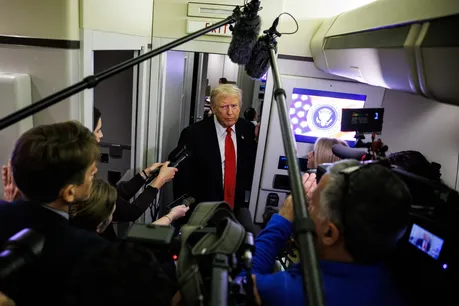
US President Donald Trump recently announced that the United States might deploy military forces or carry out air strikes in Nigeria in response to what he described as the large-scale killing of Christians. He further threatened to suspend all US aid if the Nigerian government failed to act. This high-profile threat arrived amid serious security challenges in Nigeria, but the claim that it reflects a clear religious genocide or a purely Christian-targeted massacre is not supported by the full picture.
Nigeria is a vast country with more than two hundred million people, roughly split between Muslims and Christians. The violence that affects it arises from many sources: insurgent groups such as Boko Haram and Islamic State West Africa Province in the northeast, armed bandits in the northwest and central regions, and clashes between farming and herding communities often tied to land, water, climate change and economic marginalisation. While Christians have certainly been victims, so have many Muslims, and the motivations are seldom exclusively religious. Experts emphasise that the geography of violence matters a great deal. Most attacks have taken place in regions already suffering weak state presence, poverty and conflict over resources. To label the situation as a targeted campaign against Christians misreads much of the complexity.
The Nigerian government has publicly rejected the claim that it tolerates large-scale persecution of Christians. President Bola Tinubu said that the characterisation of Nigeria as a country of religious intolerance “does not reflect our national reality.” He stressed that the government is committed to protecting citizens of all faiths and working with international partners. Many analysts agree with that more nuanced view. They say the core issue in many of the violence-ridden regions is social and economic collapse, failed governance, contested land rights, rather than a simple Christian-versus-Muslim narrative.
This is not to say the situation is not grave. Tens of thousands of people have died in Nigeria over the past few years in conflict, and millions have been displaced. The insurgency in the northeast has destroyed towns and disrupted entire communities. The bandit attacks and farmer-herder conflict in the northwest and central regions are brutal and often indiscriminate. But to single out religion as the main driver oversimplifies the reality and risks diverting attention from the structural problems: weak governance, failure of security forces, poverty, environmental stress and inter-communal grievances.
Trump’s threat of military intervention carries serious implications. First it shifts attention away from helping Nigeria build capacity, instead suggesting an external intervention that may undermine Nigeria’s sovereignty or worsen instability. Second, if the narrative emphasises one religious group as the primary victim, it could inflame tensions internally and feed extremist propaganda. Third, it may distort US policy priorities: instead of focusing aid, partnership and capacity-building, it risks turning toward coercion or punitive posture.
A more constructive approach would recognise the multi‐dimensional nature of Nigeria’s security challenges. It would support Nigerian institutions, help build better policing and justice systems, address land and resource conflicts, strengthen border and counter-terror capabilities, and foster social inclusion across religious and ethnic lines. It would also base any foreign engagement on accurate assessments, respectful of Nigeria’s sovereignty and mindful of unintended consequences.
In summary, Trump’s military threat to Nigeria over alleged mass killings of Christians does not align with the full reality of violence in the country. Nigeria’s violence is complex, driven by many interlocking factors beyond religion alone. Oversimplified narratives and heavy handed threats risk misdiagnosing the problem and misdirecting policy. For Nigeria, the task remains daunting but is fundamentally about stabilising conflict zones, improving governance, restoring state presence and building a society where all citizens regardless of faith feel protected.
Let me know if you’d like a deeper dive into specific regions of Nigeria, the data on violence by region, or the history of the conflicts that underlie the country’s security challenges


Leave a Reply