

Astrophysicist and documentary photographer Jordi Busqué invites us to journey beyond the boundaries of science and into the realm of awe with 11 extraordinary images of the night sky. His photographs are not only records of celestial beauty but also urgent reminders of what humanity risks losing.
Before the early 19th century, when Paris became the first European city to illuminate its streets with gas lamps, the Milky Way was as familiar to most people as the Moon is today. For centuries, our ancestors navigated by starlight, wove myths around constellations, and measured time against the slow wheel of the heavens. But in the past hundred years—barely a blink in astronomical time—light pollution has grown so pervasive that many have never truly seen a star-filled sky.
Busqué remembers a time when he could. As a child, he spent summer weeks in Peñarroyas, his grandmother’s tiny village in Spain’s Teruel province. With just four permanent residents, Peñarroyas had no streetlights to outshine the cosmos. The skies there were astonishing—so crowded with stars he couldn’t distinguish the major constellations. “It felt,” he recalls, “as if I’d stepped onto a rocket and blasted into space.” Those memories set him on a path that would intertwine astronomy and art.
In his teens, Busqué began experimenting with photography, capturing the Milky Way rising behind the rugged hills of Peñarroyas. Those first images were the seeds of a lifelong passion. Years later, as a professional astrophysicist, the experience of standing under the stars gained new depth: he now understood the science behind the beauty. But knowledge did not diminish wonder. “If anything,” he says, “it made every glimpse of the night sky even more meaningful.”
Today, Busqué travels the globe as a photographer and science communicator, searching for the few remaining places where darkness still reigns. His latest series takes us from Morocco to Patagonia, across the Atacama Desert and over the Bolivian salt flats, revealing rare sanctuaries of natural night. These images are breathtaking records of a vanishing world.
One of his most striking panoramas was taken in Chile’s Atacama Desert, at an altitude of nearly 4,000 m. Under one of the driest skies on Earth—where clear nights are almost guaranteed—the Milky Way arches across the heavens. On the left of the frame glows its galactic core, the brightest, most luminous region of our home galaxy. “The Atacama is perfect for stargazing,” Busqué explains. “There are no clouds, no humidity, and very little light from distant towns—just infinite stars.”
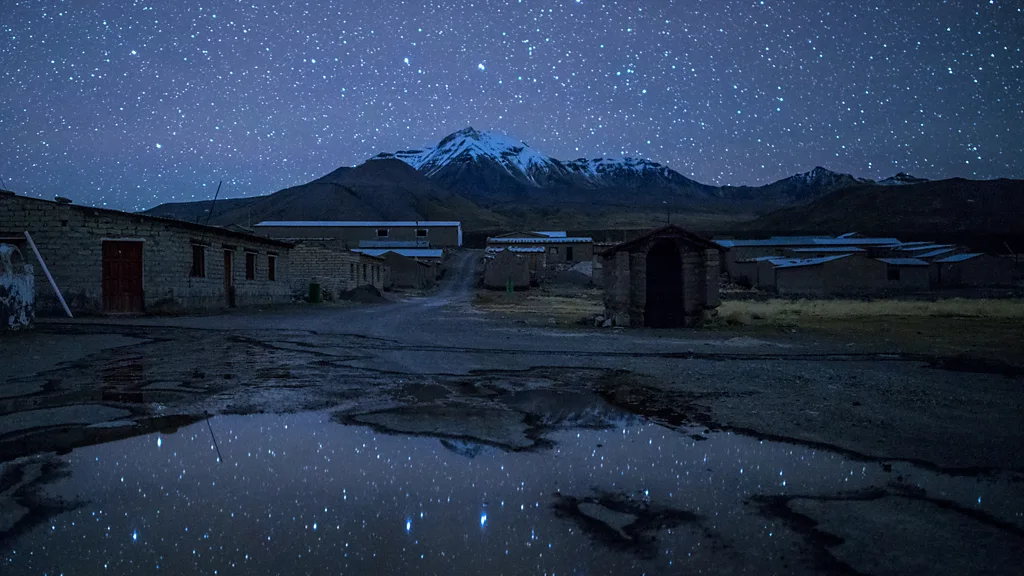
Another photograph, captured in an abandoned northern Chilean village, offers a playful twist. The Big Dipper, part of the constellation Ursa Major, hangs upside down—a reminder that the sky’s familiar patterns change depending on your hemisphere. A shallow pool of water reflects the stars right-side up, a poetic correction courtesy of the Earth itself.
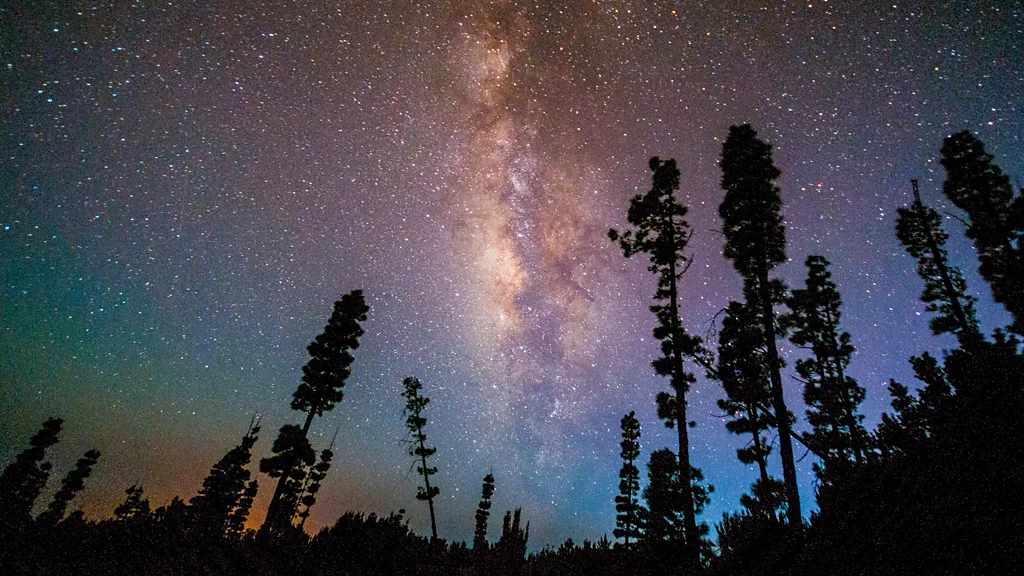
From Spain’s Canary Islands, Busqué recorded another vivid image of the Milky Way’s centre glowing brightly against the summer sky. “Our solar system orbits the Milky Way’s centre once every 250 million years,” he notes. “Given Earth’s age of about 4.5 billion years, our planet has circled the galaxy roughly twenty times.” Such statistics underscore how fleeting human lifespans are compared to cosmic rhythms.
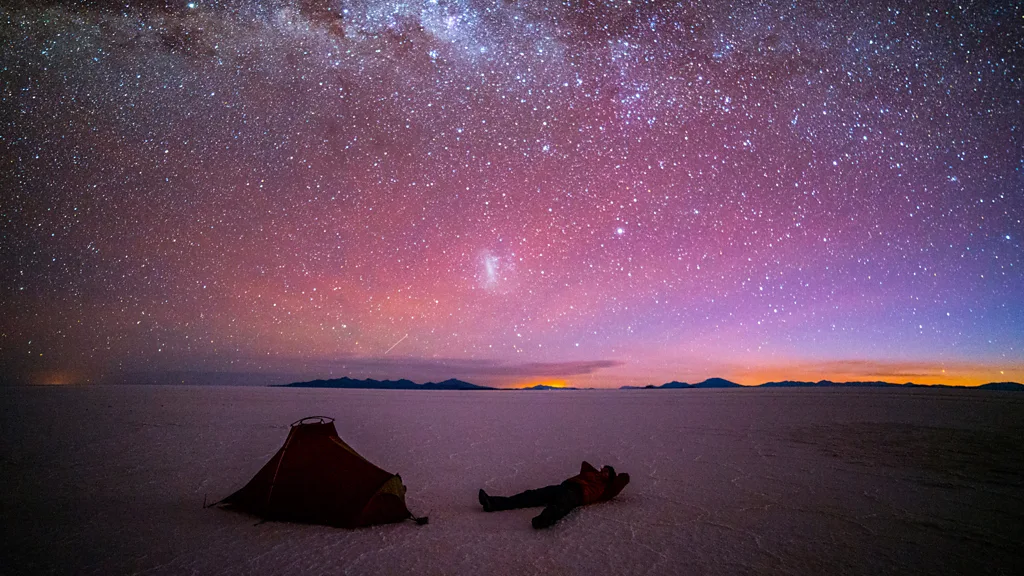
Busqué also seeks phenomena that even seasoned stargazers rarely witness—like zodiacal light. This faint, triangular glow is caused by sunlight reflecting off dust particles scattered through the solar system. “Seeing it is one of the ultimate tests of a truly dark sky,” he says. Capturing the phenomenon requires perfect timing: in spring, look for it about an hour after sunset; in autumn, an hour before dawn. In summer and winter, the angle is too shallow for it to soar high in the sky. In Muslim tradition, this glow is called the “false dawn” because, in desert nights, it can easily be mistaken for sunrise. Busqué photographed the zodiacal light in the salt deserts of Bolivia, 3,700 m above sea level—a breathtaking scene that evokes both science and spirituality.
In another Bolivian image, he points to a soft, cloud-like smudge—the Large Magellanic Cloud, a dwarf galaxy and companion to the Milky Way. First recorded for Europeans by Antonio Pigafetta during Magellan’s circumnavigation of the globe (1519–1522), the galaxy has been a familiar southern-sky landmark for millennia to Indigenous peoples. Captured amid towering cacti, Busqué’s photograph is a testament to the world’s enduring astronomical heritage.
Perhaps the most intimate of his images is a self-portrait taken on Bolivia’s Uyuni Salt Flats. Lying on his back with no trees or mountains to frame his view, Busqué gazed upward until the horizon disappeared. “In that moment,” he says, “it felt like floating in space—or standing on the Moon.”
He encourages everyone to seek out this experience, even briefly. “When you look up at a starry night, you gain perspective,” he reflects. “The universe’s immensity urges you to reconsider your priorities. Our lives are fleeting compared to the stars, yet our planet is an extraordinary home. We must treat it with care.”
Busqué’s photographs are more than pretty pictures; they are invitations. They call us to remember that the night sky has always been a shared human heritage—one that guided our ancestors, inspired our myths, and shaped our understanding of time and place. In a world where city lights increasingly drown out the stars, these images remind us of what is slipping away.
The next time you find yourself far from urban glare, look up. Let your eyes adjust. Wait for the heavens to unfold, just as they did for countless generations before us. In those moments, you may find—as Busqué has—that awe and humility are as infinite as the universe itself.


Leave a Reply