

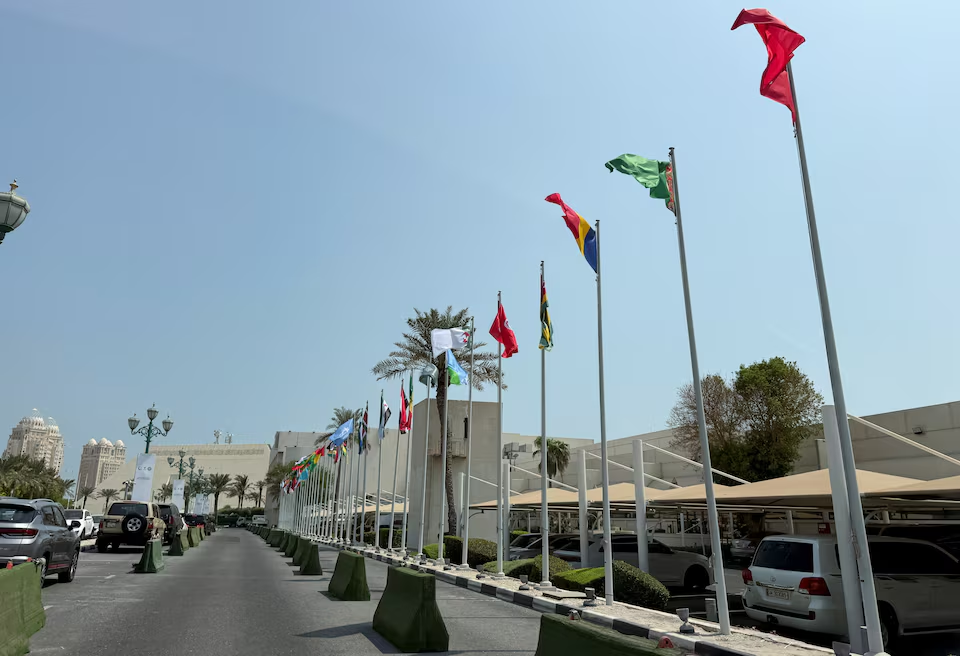
On September 9, 2025, an Israeli strike in Doha that targeted Hamas leaders set off a regional political shockwave. The attack — which Qatari authorities say killed several Hamas operatives and a Qatari internal security officer — prompted a swift response from Doha and an emergency diplomatic convening: an Arab–Islamic summit in Qatar intended to coordinate a collective reply and to underscore regional solidarity with the host state. Over the following days the summit became the focal point of diplomatic positioning across the Arab and Muslim world, with participating nations condemning the strike, demanding accountability, and warning against a further erosion of regional stability. This blog unpacks what happened, why it matters, who said what, and what the likely short- and medium-term consequences are — drawing on the latest reporting and official statements. Gulf News+4Reuters+4AP News+4
What happened in Doha? The strike and the immediate fallout
According to Qatari officials and multiple international news agencies, Israeli forces carried out an airstrike in Doha on September 9 that targeted a grouping of Hamas leaders who were present in the Qatari capital as part of the mediating track on Gaza. Qatari authorities reported fatalities among the Hamas delegation as well as the tragic death of a Qatari internal security officer. Doha described the attack in the strongest terms — labelling it “state terrorism” and an assault on Qatari sovereignty. The strike also occurred while Qatar was actively engaged in shuttle diplomacy, hosting mediators and negotiators who were working toward ceasefire discussions. AP News+1
Doha’s account was followed almost immediately by a diplomatic outcry. The Qatari leadership called for an emergency gathering of Arab and Muslim foreign ministers and leaders to coordinate a unified reaction. That gathering took place in mid-September and evolved into a formal summit, with Arab League and Organization of Islamic Cooperation participants convening in Doha to “plot a course of action,” as local reporting put it. From the outset, the summit’s stated purpose was twofold: to condemn the breach of Qatari sovereignty and to press for accountability while simultaneously defending Doha’s role as a mediator in the Gaza impasse. Al Jazeera+1
Who attended and what the summit declared
The summit drew a wide swathe of regional players — from Gulf monarchies to North African capitals and major non-Gulf Arab states. Although the final list of attendees fluctuated with last-minute travel decisions and political calculations, the representation included key Arab League members and OIC participants. Draft resolutions circulated before the summit emphasized condemnation of the strike and articulated support for Qatar’s right to host diplomatic negotiations. Importantly, while the draft language stopped short of punitive economic or diplomatic measures against Israel, it crystallized a clear political message: the attack was destabilizing and unacceptable to several states that have recently been recalibrating their relationships with Israel. Reuters+1
Public statements from Doha’s leadership, including Foreign Minister Sheikh Mohammed bin Abdulrahman Al Thani, framed the incident as part of a pattern of actions that threatened regional mediating channels. Qatar pushed the summit to adopt language that would both condemn the strike and call for international accountability, pointing to the dangers of unchecked unilateral military actions on the soil of neighboring (or friendly) states. Arab League Secretary-General Ahmed Aboul Gheit and other senior officials publicly echoed those warnings. AP News+1
Reactions: regional unity — with important fissures
One of the summit’s most striking outcomes was the relatively swift alignment of many Arab and Islamic states around Doha’s position. Gulf neighbors, some of whom normalized ties with Israel in recent years, faced a delicate balancing act: whether to prioritize newly forged relations with Tel Aviv or to stand with a fellow Gulf state whose sovereignty had arguably been violated. Several Gulf states, including the UAE and others that have grown closer to Israel since 2020, expressed clear concern about the ramifications of a strike on Qatari soil; those statements underlined that strategic relationships with Israel are not unconditional and can be strained by actions seen as aggressive or destabilizing. Reuters+1
At the same time, not every participant pushed for punitive measures; the final communiqué was carefully worded. A draft seen by international outlets condemned the attack and criticized attempts to “reshape regional dynamics,” but did not immediately propose coordinated sanctions or severing of ties. That restraint reflects a pragmatic realism among many states: while displeasure was palpable, escalation into a diplomatic rupture with Israel would carry complex strategic costs — particularly for countries that rely on economic ties, security cooperation, or U.S. facilitation. In short, unity existed in rhetorical condemnation, but the summit also revealed limits to how far states were willing to escalate. Reuters+1
Where the U.S. and other global actors fit in
International reaction was mixed and instructive. The United States — an ally of Israel but also a partner to several Gulf states including Qatar — found itself in an awkward diplomatic position. High-level exchanges followed: Qatar’s prime minister held talks in Washington with senior U.S. officials and, according to coverage, also met with U.S. political leaders in New York while trying to marshal international support. Publicly, Washington stressed the need for de-escalation while also reiterating the U.S. commitment to Israel’s security. But those private and public conversations reflected a larger reality: U.S. influence matters, and American officials were actively engaged in crisis management behind the scenes. Al Jazeera+1
Other global capitals walked a tightrope between upholding principles of sovereignty and balancing relationships with Israel and regional partners. The summit’s outcomes therefore served not only as a regional message to Tel Aviv, but as a signal to Western capitals that Gulf states expect their security concerns and diplomatic prerogatives to be respected. The event amplified long-standing Arab complaints about perceived double standards in how international law is applied across conflicts and borders. Gulf News+1
What the summit’s language does — and does not — accomplish
The summit’s final statement carried important symbolic weight: it rallied a bloc of Arab and Islamic states around a shared condemnation of a strike on sovereign Qatari territory and underscored Doha’s role as a mediator in the Gaza conflict. Symbolism matters in diplomacy — it shapes narratives, constrains future rhetoric, and frames international debate. But symbolism is not the same as concrete leverage. The draft resolution, while forceful in tone, stopped short of proposing concrete sanctions, military measures, or other direct reprisals against Israel. That restraint was strategic: many states wanted to avoid a crisis that could spiral into broader confrontation or severances that would be costly to reverse. Reuters
Practically speaking, then, the summit’s immediate material effect is limited. What it does do, however, is make clear that Israel’s action will not be treated as a local or isolated incident; it has turned into a matter of regional diplomacy and reputational consequence. For Doha, the declaration of support strengthens its position in international forums and gives it additional diplomatic capital when demanding investigation, reparations, or assurances about the safety of envoys and mediators. For other Arab capitals, the summit offers a public mechanism to express displeasure without immediately burning bridges — an important hedging strategy. Reuters+1
Broader context: why Doha matters in the Gaza process
Qatar has long been an indispensable broker in the Israel-Gaza dynamic. Doha has maintained lines to Hamas while also hosting Western and Arab interlocutors, acting as a hub for hostage negotiations and humanitarian mediation. That role is precisely why the strike was so consequential: an attack that threatens Doha’s neutrality or safety risks closing off one of the few available channels for negotiation. The summit’s defenders of Qatar framed the strike as counterproductive to de-escalation and argue that striking mediators will only harden positions, diminish trust, and complicate any future ceasefire architecture. AP News+1
Prime Minister Benjamin Netanyahu of Israel, meanwhile, defended the operation as a necessary step to degrade Hamas leadership and remove obstructions to ending the threat posed by the group. In statements reported after the strike, Netanyahu suggested that removing senior Hamas figures could clear the way for faster progress on hostage release and conflict termination. This illustrates a central contradiction: what some see as an operational necessity is perceived by others as a strategic error that undermines peace prospects by removing mediating intermediaries. Reuters
Possible next steps and scenarios
Looking ahead, several plausible scenarios could unfold:
- Diplomatic investigations and calls for accountability. The summit may put diplomatic pressure on Israel to account for the strike, possibly pushing for an independent inquiry or for international bodies to get involved in documenting violations of sovereignty. Doha will use the summit’s statement to push multilaterally. Reuters
- Managed cooling vs. escalation. Many states prefer a controlled de-escalation: public rebukes combined with back-channel diplomacy to avoid wider conflict. If Washington and other mediators can facilitate face-saving steps for parties involved, the crisis could be contained. Al Jazeera
- A hardened negotiating environment. If Israeli tactics continue to target mediating hubs or if Hamas interprets strikes as reason to harden demands, negotiating conditions could worsen — making ceasefire and hostage negotiations more difficult. Qatar’s capacity to host talks could be impaired if it believes mediators are not safe. AP News
- Regional realignments. The incident might prompt some Gulf states to reassess the terms of their relationship with Israel, at least temporarily. That reassessment could take the form of diplomatic protests, reduced engagement, or closer coordination among Arab states to protect shared security interests. Gulf News
Why this matters beyond immediate headlines
Beyond the immediate political theater, the summit is a stress-test for a number of broader dynamics: the durability of recent Arab-Israeli normalization moves, the resilience of Qatar’s mediating role, the limits of unilateral military action in a crowded diplomatic landscape, and the capacity of international actors to prevent crisis spillovers. If mediators are no longer perceived as safe, the entire architecture of incremental, brokered agreements — which have historically relied on discreet, off-the-record channels — becomes more brittle. In a conflict as protracted and contested as the Israel-Gaza war, removing even a single node of negotiation can have outsized effects on prospects for peace or humanitarian relief. AP News+1
Final reflections: diplomacy, deterrence, and the need for restraint
The Arab–Islamic summit in Doha was a timely reminder that in modern geopolitics, tactical military actions can produce strategic diplomatic costs. The gathering’s solidarity behind Qatar served both as a rebuke to the strike and as a plea for the preservation of mediation channels — a plea that many diplomats and humanitarian actors will likely echo in coming weeks. The summit did not, and perhaps could not, impose immediate hard costs on Israel; what it did deliver was political clarity and a unified regional narrative that frames the strike as destabilizing.
If there is a broader lesson here, it is that enforcement of international norms — particularly the norms governing state sovereignty and the protection of mediators — depends not only on law and institutions but on sustained diplomatic will. The Doha summit probed that will. Whether the unified rhetoric demonstrated there translates into sustained pressure, protective mechanisms for mediators, or concrete policy shifts remains to be seen. For now, Doha has reclaimed the moral high ground in the immediate aftermath of an attack on its soil — and the region has, at least temporarily, rallied behind it.


Leave a Reply