

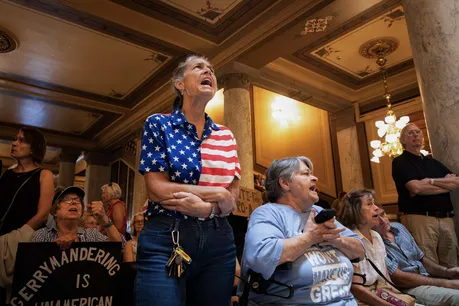
Across the United States a new political battle is quietly intensifying long before the 2026 elections. This fight is not happening on debate stages or in campaign rallies but inside courts, state legislatures, and private strategy rooms. The issue at the center of the conflict is redistricting, the drawing of voting maps that will determine how political power is distributed for the next decade. What makes the current struggle different is the level of money pouring in from wealthy donors who see redistricting as one of the most decisive tools in shaping future election outcomes.
Redistricting usually happens every ten years after the national census, but legal challenges, population shifts, and court rulings have kept the process active well beyond the usual cycle. With control of Congress and state governments at stake, both major political parties now treat map drawing as a frontline battle rather than a technical process. As a result large donors, political action committees, and lobbying networks are investing heavily to influence who controls the redistricting machinery.
Wealthy donors are not simply giving to individual candidates. They are funding legal teams, research organizations, data analysts, and advocacy groups that specialize in reshaping maps in ways that favor a certain party or policy agenda. Some donors are backing lawsuits to challenge existing maps while others are helping state lawmakers push for new lines that protect incumbents or weaken the opposition. The amounts are significant and growing because lawmakers now understand that a favorable map can secure a political advantage more powerful than any campaign advertisement.
The rise of partisan redistricting battles also reflects a deeper shift in American politics. Voters are increasingly locked into predictable demographic patterns, which means that control of a few districts can decide an entire election cycle. Rather than persuading voters, some strategists focus on designing districts where one party has an automatic advantage. This is why the stakes are so high. Redistricting does not just influence one race, it determines the landscape for many elections to come.
Critics argue that this flood of donor money is turning redistricting into a private contest between elites rather than a democratic process. They claim that public input is shrinking while political insiders negotiate boundaries behind closed doors. Reform groups advocate for independent commissions or neutral mapping software to prevent partisan manipulation. However these groups face financial disadvantages because they are often funded by small donors while partisan groups enjoy millions from private wealth and national networks.
Supporters of donor funded redistricting efforts defend their involvement by saying they are protecting voter rights and correcting unfair maps drawn by the other side. Both parties use the same argument, showing how deeply polarized the issue has become. What was once a dry policy matter has now become a high stakes proxy war for long term control of power.
The 2026 elections will be the first major national cycle influenced by these latest map battles. Dozens of congressional districts and state legislative seats could shift based on new legal rulings expected in the next year. If the courts uphold certain maps, one party could gain a structural advantage before voting even begins. If the courts reject them, the process could restart again leaving candidates uncertain about where they will run.
The growing role of rich donors in redistricting highlights a broader trend in American politics where the most influential fights are no longer fought in public but in legal and procedural arenas. As long as control of maps determines control of power the money and pressure will continue to build. The question now is whether voters will recognize how much their political reality has already been shaped before they even go to the polls.


Leave a Reply