

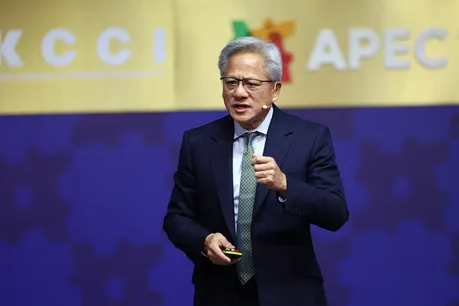
Nvidia Chief Executive Officer Jensen Huang has expressed optimism that the company may still find a way to sell its next-generation Blackwell chips to China despite tightening US export restrictions. His comments highlight the delicate balance the chipmaker faces between complying with government regulations and maintaining access to one of its largest markets.
Speaking at a recent industry event, Huang acknowledged that the US government’s new rules significantly limit the types of advanced semiconductors that can be shipped to China, particularly those used in artificial intelligence and high-performance computing. However, he noted that Nvidia is exploring possible versions of its Blackwell architecture that could meet regulatory requirements while still serving the needs of Chinese customers.
The Blackwell line, which represents Nvidia’s most powerful generation of AI chips yet, is designed to accelerate complex computing tasks for training large-scale machine learning models. These chips are in high demand globally as companies and governments race to build advanced AI systems. The export restrictions, aimed at preventing China from gaining access to cutting-edge AI capabilities with potential military applications, have forced Nvidia to rethink how it conducts business in one of the world’s largest technology markets.
Huang said the company remains committed to supporting its customers in China, emphasizing that Nvidia has long maintained a strong presence there through partnerships and research collaborations. He added that the firm continues to work closely with regulators to ensure full compliance while seeking pathways that allow for “fair and lawful” trade. Nvidia’s goal, according to Huang, is to balance innovation with responsibility and ensure that AI technology can be developed safely and inclusively around the world.
The US government’s export curbs have already had a major impact on Nvidia’s sales to China, which previously accounted for a significant portion of its data center revenue. The company has reportedly been developing alternative chip models with lower performance thresholds that fall below the restricted specifications, though these products may not deliver the same level of computing power as the original Blackwell line.
Industry analysts believe Huang’s remarks are a signal that Nvidia is determined to retain its foothold in China, even if it means sacrificing some performance or profit margins. China remains a vital market for AI hardware, with massive demand from tech giants, research institutions, and cloud service providers. Losing access entirely could open the door for local competitors to gain ground and accelerate the development of domestic alternatives.
Despite the challenges, Nvidia’s long-term prospects remain strong. The global appetite for AI chips continues to expand, driven by cloud computing, autonomous vehicles, and generative AI applications. Huang emphasized that while geopolitical tensions may reshape how companies operate internationally, innovation will continue to move forward.
In essence, Nvidia’s strategy reflects a broader reality of the modern semiconductor industry—one where technology leadership, national security, and market access are increasingly intertwined. As the company navigates this complex landscape, Huang’s optimism suggests Nvidia is determined to stay engaged in China while adapting to the rapidly evolving rules of global technology trade.


Leave a Reply