

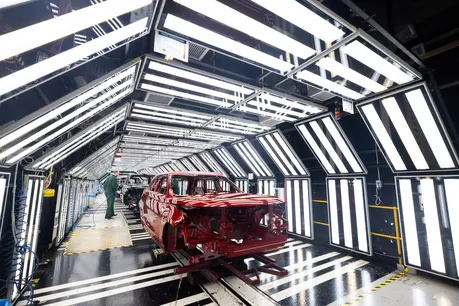
The United Kingdom’s automotive industry has faced one of its worst disruptions in recent history after a major cyberattack struck Jaguar Land Rover. The incident led to a 27 percent drop in car production, marking a severe blow to both the company and the broader manufacturing sector. The attack exposed how dependent modern production systems have become on digital networks and how vulnerable they are to targeted cyber threats.
Jaguar Land Rover, one of Britain’s largest carmakers, was forced to halt operations across several of its manufacturing plants after hackers infiltrated its IT systems. Production lines came to a standstill, suppliers were unable to deliver components, and thousands of workers faced delays and temporary shutdowns. The company confirmed that its systems were compromised, disrupting the flow of parts, scheduling, and logistics.
Industry analysts estimate that the disruption wiped out nearly a quarter of the UK’s total car output for the affected month. This fall in production has pushed overall manufacturing levels to their lowest in over seven decades. The financial damage is believed to be in the billions, as halted production and missed exports have compounded the losses.
The attack has also raised serious concerns about the cyber resilience of the automotive sector. As cars become more digitally integrated and factories rely on automated systems, the risk of cyber incidents has grown exponentially. Jaguar Land Rover’s experience is a wake-up call for manufacturers that still rely heavily on centralized data systems without sufficient backup protections.
Experts believe the hackers targeted the company’s operational technology infrastructure, freezing essential systems that control assembly lines and supply chain coordination. It took weeks for Jaguar Land Rover to begin restoring production, and full recovery could take months. The disruption not only affected the company’s output but also its suppliers, many of whom rely almost entirely on JLR contracts for their business survival.
The British government has expressed concern about the incident and is working with cybersecurity agencies to investigate its origins. Officials have emphasized the need for stronger digital defenses and contingency plans in critical industries. Many companies are now being urged to invest more in cybersecurity audits, employee training, and resilient IT infrastructure to avoid similar disasters in the future.
The incident has also reignited the debate about the cost of automation. While digital systems make factories more efficient, they also open doors for cybercriminals to cause immense damage. The balance between innovation and security has become a defining challenge for modern manufacturing.
In the aftermath of the attack, Jaguar Land Rover has pledged to rebuild its systems with enhanced cybersecurity measures and greater operational transparency. The company is also reviewing its data protection policies and engaging with external experts to fortify its defenses.
The Jaguar Land Rover cyberattack serves as a stark reminder that the future of manufacturing is not just about machines and automation but also about digital resilience. As industries continue to embrace artificial intelligence, cloud computing, and interconnected systems, protecting those networks from cyber threats will be as critical as building the cars themselves.


Leave a Reply