

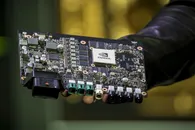
Intel’s shares surged following news that Nvidia has committed a $5 billion investment in the company, a move that has captured the attention of investors and analysts alike. The announcement marks a significant collaboration between two of the world’s largest semiconductor companies and underscores the growing interdependence within the chip industry. Market observers see the investment as a vote of confidence in Intel’s technology roadmap, while also signaling potential synergies in areas such as artificial intelligence, high-performance computing, and advanced semiconductor manufacturing.
Nvidia’s investment comes at a time when the semiconductor sector is experiencing rapid transformation. Demand for chips that power AI, data centers, and cloud computing has skyrocketed, creating opportunities for both Intel and Nvidia to expand their capabilities. By injecting capital into Intel, Nvidia not only strengthens Intel’s balance sheet but also positions both companies to collaborate on cutting-edge technologies. Analysts believe this partnership could accelerate the development of next-generation processors, GPUs, and AI-focused hardware, benefiting the broader technology ecosystem.
Intel’s stock reacted positively to the news, reflecting investor optimism about the potential financial and strategic benefits of the deal. The market sees Nvidia’s $5 billion stake as a strong endorsement of Intel’s long-term strategy, particularly as the company ramps up its investment in semiconductor manufacturing and advanced chip designs. Intel has been focused on regaining market share in key areas such as CPUs and data center chips, and this investment could provide additional resources to accelerate innovation and scale production.
Beyond the immediate financial boost, the collaboration may open the door to joint technology initiatives. Both companies have complementary strengths: Nvidia excels in graphics processing and AI hardware, while Intel brings decades of experience in CPU design and large-scale manufacturing. Combining these capabilities could result in new chip architectures that enhance performance, efficiency, and scalability. Such advancements would be particularly valuable in AI training systems, autonomous vehicles, and other high-performance computing applications.
The investment also reflects broader trends in the semiconductor industry, where collaboration and strategic partnerships are becoming increasingly important. Global chip demand continues to grow, but supply chain challenges and rising production costs make it essential for companies to work together to share risk and accelerate innovation. Nvidia’s move to invest in Intel highlights this trend and suggests that major players are seeking more integrated approaches to compete in the fast-evolving technology landscape.
For investors, the announcement provides reassurance about Intel’s growth prospects. After facing intense competition from rivals and dealing with delays in chip development, Intel now has access to significant capital that can support research and development, capacity expansion, and potential acquisitions. Nvidia’s backing may also improve market confidence in Intel’s ability to execute its roadmap and maintain relevance in the semiconductor market.
In conclusion, Intel’s stock surge following Nvidia’s $5 billion investment signals a new chapter for the semiconductor giant. The partnership highlights the increasing importance of strategic collaboration in an industry defined by rapid technological change. With additional capital, shared expertise, and potential joint innovations, Intel is well-positioned to strengthen its competitive edge while contributing to the broader evolution of AI and high-performance computing technologies.


Leave a Reply