

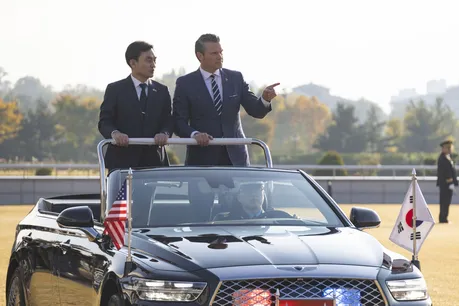
The alliance between the United States and South Korea is entering a notable evolution. During his recent visit to Seoul, US Defense Secretary Pete Hegseth affirmed that while the core of the US-South Korea military partnership remains focused on deterring threats from North Korea, the United States is now examining ways to give its forces stationed in South Korea greater flexibility to respond to broader regional contingencies. The comments mark a subtle but meaningful shift in the role of the roughly 28,500 US troops based on the peninsula and reflect changing strategic priorities in the Indo-Pacific region.
Hegseth’s remarks came alongside his counterpart, South Korean Defence Minister Ahn Gyu‑back, after joint visits and talks including a stop at the heavily fortified Demilitarised Zone with North Korea. He stated that the deterrence of North Korean aggression would continue to anchor the alliance, but added that there is “no doubt that flexibility for regional contingencies is something we would take a look at.” The phrase underscores how Washington is seeking to adjust force posture in order to address emerging threats beyond the immediate Korean peninsula, such as possible conflicts involving China.
For South Korea the offer of enhanced US military flexibility carries potential benefits and risks. On the one hand, it signals deeper integration into broader multinational defence networks and access to greater US operational support in the region. On the other hand, it raises questions about how such expanded roles might affect South Korea’s own strategic autonomy and its relations with neighbouring powers. Historically South Korea has preferred to emphasise its defence against North Korea and maintained caution about becoming entangled in other regional confrontations. The idea of US troops carrying out missions beyond the peninsula therefore may require sensitive negotiations and clear definition of roles.
From the United States’ perspective the shift is tied to broader strategic recalibration in the Indo-Pacific. Washington views China’s growing military capabilities and assertiveness around Taiwan and in the South and East China Seas as likely to generate scenarios in which allied forces must operate in a networked way across multiple theatres. Having US forces in South Korea prepared to respond to these scenarios strengthens the US ability to project power and support allies from forward-positioned troops. It also enables quicker response times and greater deterrence credibility in a region of heightened uncertainty.
However there are practical and political complexities. Expanding the mission set of US forces in South Korea would require new command arrangements, logistic support, regional basing agreements and possibly adjustments to status-of-forces treaties. South Korea may face domestic political resistance if its territory is seen as becoming a springboard for missions far from the peninsula. Public sentiment in Korea tends to focus sharply on the North Korean threat and sensitive to alignment with US global strategy. Moreover China is likely to view such changes with unease, raising diplomatic risks that both Seoul and Washington must heed.
In addition the operational demands of broader regional missions are significant. Troops stationed in South Korea were originally configured primarily for peninsula-focused defence tasks. Adapting them for regional mobility, naval or air operations far beyond Korean borders will carry costs and require overhauls in readiness, training and equipment alignments. Whether the existing footprint can sustain such expanded roles without dilution of its core task remains to be tested.
In summary Secretary Hegseth’s comments mark a shift in thinking within the US-South Korea alliance. While deterrence of North Korea remains central, the idea of US forces in South Korea contributing to wider regional security is now on the table. The outcome will depend on how both countries manage the balance between regional ambition and national priorities, how they negotiate the details of expanded roles, and how they respond to the reactions of rivals. For now the message is clear: the alliance is adapting to a broader strategic environment


Leave a Reply