

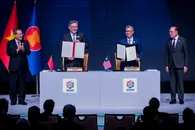
China has taken a major step in strengthening its regional economic influence by expanding its trade pact with several Asian economies that were once the focus of US trade diplomacy under former President Donald Trump. The move signals Beijing’s growing ambition to position itself as the leading economic partner in Asia, deepening ties through trade, investment, and infrastructure cooperation.
The latest expansion of the Regional Comprehensive Economic Partnership, or RCEP, involves the inclusion of new trade initiatives and upgraded agreements with key Southeast Asian and Pacific nations. These countries, which were previously courted by Washington through the now-defunct Trans-Pacific Partnership, are increasingly aligning their trade interests with China’s expanding network. By broadening the pact’s reach, Beijing aims to solidify its role as the central hub of regional commerce and supply chains.
Chinese officials have framed the move as part of the nation’s strategy to promote open trade and economic integration across Asia. The agreement reduces tariffs, simplifies customs procedures, and encourages investment in digital trade, green technologies, and cross-border services. This approach reflects China’s long-term goal of creating an interconnected economic zone that can sustain growth independently of Western markets.
For many Asian economies, the benefits are clear. Participation in an expanded RCEP opens doors to a larger market, more stable supply chains, and enhanced access to Chinese investment. Countries such as Malaysia, Indonesia, Vietnam, and Thailand see the pact as a means to attract manufacturing and logistics projects as companies seek to diversify production beyond China while remaining within the broader Asian trade ecosystem.
However, the geopolitical implications are just as significant as the economic ones. The expansion comes at a time when the United States is attempting to rebuild its influence in Asia through new security alliances and technology partnerships. Yet Washington’s absence from a comprehensive trade framework in the region has allowed China to gain ground. By strengthening its trade ties with neighbors, Beijing is filling a gap in economic leadership that many analysts say the US has struggled to reclaim since withdrawing from the TPP in 2017.
Chinese policymakers have been quick to highlight the contrast between their approach and that of the United States. While Washington’s strategy often focuses on security and competition, Beijing presents itself as a partner in shared economic development. This message has resonated with nations seeking stability, market access, and infrastructure investment rather than political confrontation.
Economists note that the expansion of RCEP could reshape trade flows across Asia over the next decade. With lower tariffs and integrated standards, regional trade is expected to grow significantly, reinforcing Asia’s role as the world’s manufacturing and innovation center. It could also accelerate the shift of global supply chains away from Western-dominated networks and toward an Asia-centric model.
Still, challenges remain. Some members are cautious about overreliance on China, especially given concerns about trade imbalances and political leverage. Others are exploring ways to balance deeper ties with Beijing while maintaining strategic relationships with the United States and its allies. The delicate balance of economic opportunity and political autonomy will shape how the pact evolves in the coming years.
In the broader view, China’s success in expanding the trade agreement marks a milestone in its economic diplomacy. It underscores the country’s ability to translate its vast market size and industrial capacity into regional influence. As the global economic landscape continues to shift, China’s strengthened trade ties across Asia could redefine the center of gravity for global commerce, establishing the region as the new heart of international trade and cooperation.


Leave a Reply